Cultural organizing celebrates and cultivates power in our liberative traditions and practices, while pursuing change and transformation at the level of collective and even subconscious beliefs, symbols and stories upon which oppressive systems are built and sustained.
According to Mariame Kaba, abolitionist organizing is a long-term, collective practice aimed at ending prisons, policing, surveillance, and punishment-based systems while building life-affirming alternatives that make those systems unnecessary.[1] Because those alternatives do not yet exist, abolitionist organizers are working towards possibility that is uncertain. Kaba acknowledges the challenges of this given we all have negative bias, the neurological predisposition two 1) pay more attention to negative input and 2) more easily internalize negative input and experiences. It is easier for people, at a neurological level, to embrace a story that is known, even if the realization of it is violent and horrible, than it is for our brains to embrace possibility that is unknown. This is one reason that fear mongering, that is, propagating a fear based story even if it is untrue, is often a successful political strategy. For the purposes of this work and inquiry into how the stories and relationships we live and practice might move towards interdependence and solidarity, I look to how organizers address this challenge and then create my own organizing resources. The arts based methodologies here come to life in both the practice led inquiry and the presentation of knowledge.
In addition to abolitionist organizing, I am pulling from, and working within frameworks of antifascist organizing and decolonial practices. There is a large intersection on the Ven diagram of these three frameworks, and I believe the intersectional space is where we must turn to address spiritual formation. Abolition organizing focuses on freedom and the abolition of carceral logics and systems. Abolition organizing also recognizes that the United States carceral system is a direct outgrowth of chattel slavery and continues to enslave and control Black bodies in particular.[2] While objective organizing wins can be witnessed and materialize through policy, the closure of a prison for example, or the prevention of a new one being built, the restoration of voting rights to felons or the end of stop and frisk policies, the manifestation of a world that is possible is glimpsed in smaller places of freedom. Ruth Wilson Gilmore asserts that
[1] Kaba, M. (2021). We do this ’til we free us: Abolitionist organizing and transforming justice. Haymarket Books.
[2] The New Jim Crow
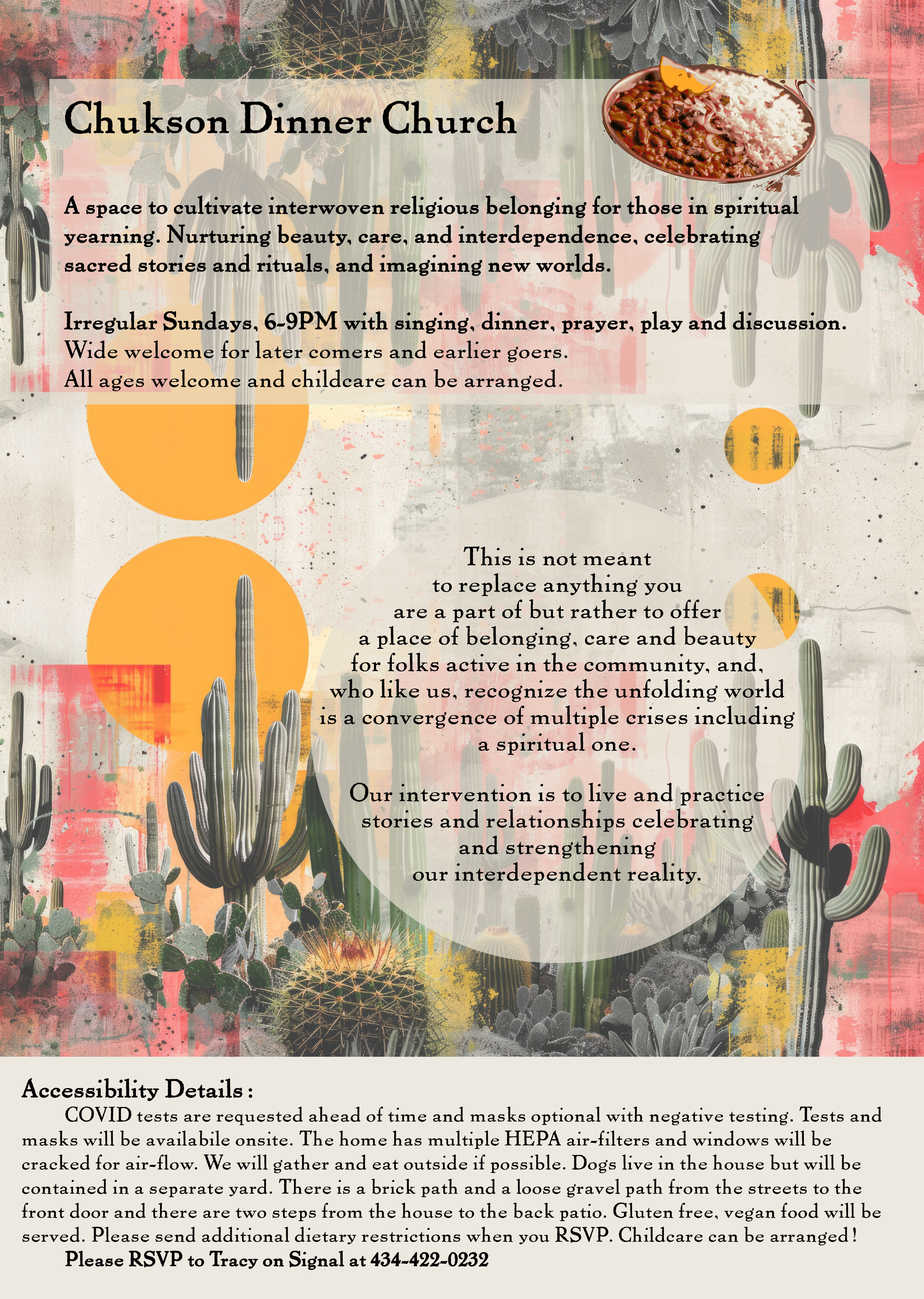
Welcome to Chukson Dinner Church! This is a space to cultivate interwoven religious belonging with others in spiritual yearning. We are, together, seeking to be a place of belonging, beauty, and care, specifically for folx active in the community who recognize the unfolding world is a convergence of multiple crises including a spiritual one.
With fascism spreading small and fear based stories of “us vs them,” our intervention is to live and practice stories and relationships celebrating and strengthening our interdependent reality.
Our spiritual formation, that is how we move towards living and practicing stories and relationships of interdependence, includes sharing meals and friendship, creative inquiry and play, community singing, inviting one another into our other organizing and spiritual practice spaces, and prayerful and practical attention to one another’s needs.

Sanctuaries Everywhere
Rapid Response, Community Care and Cultural Organizing for Now
Sanctuaries Everywhere imagines every person secure in the care of a community. This evolving series of trainings and workshops builds towards this vision with careful attention to the increasing vulnerability of people and ecosystems in the face of state violence and repression, climate catastrophe, and world ending capitalism. Sanctuaries Everywhere asserts that refuge and security are found in relationship; it is people acting together with the land, in will and purpose to care for one another, and to keep one another safe. It asserts that despite what is already lost, and what is inevitable to be lost, possibility survives in our sanctuaries of care, connection and beauty.
Trainings
Cultural Organizing and Liturgical Community Care.
4-8 hours over 1-2 days. In person or virtual.
Cultural organizing celebrates and cultivates power in our liberative traditions and practices, while pursuing change and transformation at the level of collective and even subconscious beliefs, symbols and stories upon which oppressive systems are built and sustained. It is a critical component of any long-term strategy for lasting systemic and policy change. It can also function in spaces and community built on autonomy and self-determination and be a subversive practice of freedom making in the present context of ongoing state violence and oppression. This training builds capacity for presence and attention to generational and present trauma(s) and recognizes that our unfolding world is the convergence of multiple crises including a spiritual one. Understanding spirituality as the stories and relationships we live and practice, participants identify the dominant stories and relationships facilitating destruction and authoritarianism and consider what interventions move us towards interdependence and solidarity. We explore different theories of change and our own connections and contexts to discern and imagine cultural and liturgical interventions to state violence and healing pathways to trauma. Finally, participants will design liturgical and ritual responses to care for their specific communities and hold space for long term processes of grief, justice building and cultural transformation.